
What is Total Hip Arthroplasty?

Total Hip Arthroplasty is a common orthopedic procedure used to treat advanced hip arthritis. As life expectancy increases, this procedure is expected to become even more frequent.
Replacing the damaged hip joint with a prosthesis relieves the patient from pain and improves mobility, allowing them to return to their daily activities.
Minimally Invasive Total Hip Arthroplasty is performed through a smaller incision of 8–15 cm, in contrast to the traditional hip replacement where the incision ranges from 25–30 cm. The goal of minimally invasive hip arthroplasty is to reduce pain and accelerate recovery.
How is the Total Hip Arthroplasty procedure performed?
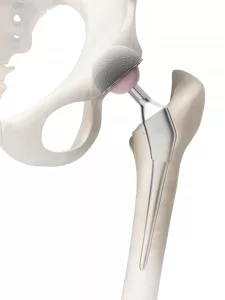
During total hip arthroplasty, the damaged cartilage and subchondral bone are removed. To do this, some soft tissues must be cut or detached.
In the MIS (Minimally Invasive Surgery) approach, the incision is much smaller, and muscle detachment is minimized compared to the traditional method.
Traditional Total Hip Arthroplasty
In traditional total hip arthroplasty:
- An incision of 25–30 cm is made on the lateral side of the hip
- Muscles are detached from the femur to allow dislocation of the femoral head and provide a clear surgical field
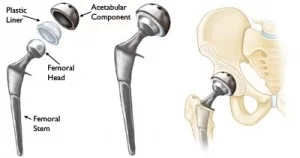
- The damaged femoral head is removed and replaced with a ceramic or metal alloy head, which is attached to the top of a metal stem inserted into the femoral canal
- The damaged acetabular surface (the socket part of the hip in the pelvis) is also removed and replaced with a metal acetabular component. Screws or bone cement may be used for added stabilization
- A liner made of polyethylene, ceramic, or metal is placed between the femoral head and the acetabular cup to provide a smooth gliding surface
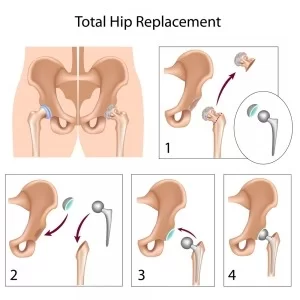
A liner made of polyethylene, ceramic, or metal is placed between the femoral head and the metal acetabular cup, providing a smooth, even sliding surface.
Get the Help You Need Today!
Minimally Invasive (MIS) Total Hip Arthroplasty
The procedure is similar but performed through a much smaller incision, with significantly less trauma and soft tissue detachment around the hip. The same materials used in the traditional method are applied, but special instruments are designed to allow precise preparation and placement of the implants through the smaller access.
In minimally invasive hip arthroplasty, the incision is typically between 8–15 cm—roughly half the length of a traditional one. The incision length depends on the patient’s size and the complexity of the hip damage.
The incision is usually made on the outer or front surface of the hip. Muscles are not cut; in cases where detachment is necessary, it is minimal and the tissues are reattached after implant placement. This allows for faster tissue healing.
Patients typically begin walking as soon as the anesthesia wears off. Hospital stays usually last 1–2 days, depending on the patient’s clinical condition. A structured rehabilitation program follows, supervised by a specialized physical therapist.σικοθεραπευτή.
Get the Help You Need Today!
Who is a suitable candidate for Minimally Invasive Total Hip Arthroplasty?
Minimally Invasive Total Hip Arthroplasty is not suitable for every patient. A specialized orthopedic surgeon, after conducting a thorough clinical and imaging assessment and considering each patient’s unique characteristics, will determine whether someone is a candidate for this technique.
Conclusion
Minimally Invasive Total Hip Arthroplasty is an evolving surgical technique that should be performed by a specialized orthopedic surgeon.
Its advantages include less tissue trauma, leading to faster and less painful recovery and a quicker return to daily activities.