
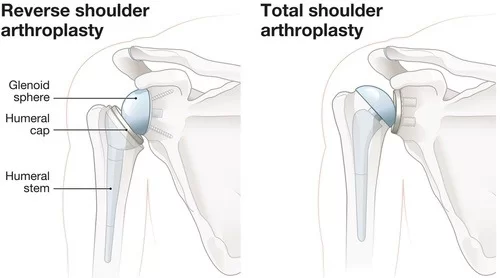
The most advanced type of shoulder arthroplasty, particularly for severe injuries and fractures, both in Europe and the U.S., is considered to be reverse total shoulder arthroplasty, as it offers solutions even for the most complex problems that can be diagnosed.
Using innovative techniques and the assistance of digital technology (specialized software and surgical navigators), the procedure becomes highly personalized, adapted to the unique anatomical needs of each patient, and can provide faster and more definitive relief from shoulder pain.
What is Reverse Total Shoulder Arthroplasty?
Reverse total shoulder arthroplasty is a complete replacement of the shoulder joint with a prosthetic implant, during which the normal anatomy of the shoulder is reversed due to rotator cuff deficiency. More specifically, the natural configuration of the glenohumeral joint is altered: the humeral head becomes concave, while the glenoid (which is naturally concave) becomes convex. This creates a stable joint that can function even in cases where the tendons are damaged or destroyed.
Preoperative Planning
Before the surgery, the patient undergoes a CT scan of the shoulder. The results are used to create a 3D model of the patient’s actual shoulder anatomy. Using specialized software, the orthopedic surgeon can pre-plan the operation. This allows for precise preoperative planning of the implant placement to match the individual anatomy of each patient.
Get the Help You Need Today!
How is Reverse Shoulder Arthroplasty Performed?
The specialized orthopedic surgeon, using minimally invasive techniques, makes a small longitudinal incision on the surface of the shoulder without damaging the muscles and tendons that are essential for shoulder function. The damaged surface is identified, removed, and replaced with the special prosthetic implant.
To ensure accurate placement of the prosthetic components, 3D-printed guides are used—these are custom-designed specifically for each individual patient.
The patient can stand up as soon as the effects of anesthesia wear off and begin moving the arm immediately. Discharge is typically possible after just one day, depending on the patient’s clinical condition and medical history.
Who is a Candidate for Reverse Shoulder Arthroplasty?
This procedure is indicated for patients with severe shoulder osteoarthritis combined with irreparable tears or insufficiency of the rotator cuff tendons (known as rotator cuff arthropathy). It is also suitable for certain types of complex fractures that cannot be treated otherwise (e.g., with internal fixation), as well as for revision surgeries following failed conventional total shoulder arthroplasties. In such cases, traditional arthroplasty would not significantly improve shoulder mobility.
Get the Help You Need Today!
What Materials Are Used in the Prosthesis?
The artificial prosthesis is made from biocompatible and highly durable materials, designed to provide long-term results.
Recovery
In the immediate postoperative period, patients are advised to use a special shoulder sling and perform simple daily mobilization exercises to ease discomfort.
The stiffness and pain experienced before the surgery typically subside within the first few weeks of recovery. The patient then follows a comprehensive rehabilitation program with a physical therapist to restore shoulder movement, stability, and muscle strength.