
Carpal Tunnel Syndrome (CTS): What Is It?
Carpal Tunnel Syndrome is a common cause of numbness and pain in the hand and fingers. It affects women more frequently than men.
Anatomy
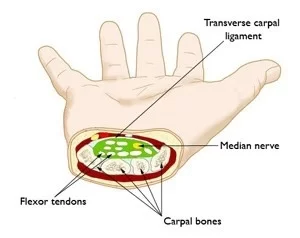
The carpal tunnel is a narrow, tubular structure on the palm side of the wrist. It is bordered below and on the sides by the carpal bones and covered on top by a tough connective tissue called the transverse carpal ligament.
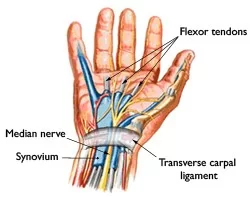
Inside the carpal tunnel run the flexor tendons of the fingers and the median nerve. The median nerve provides sensation to the palm side of the thumb, index finger, middle finger, and half of the ring finger. It also innervates the thenar muscles — the muscles at the base of the thumb that control its movement.είκτη, του μέσο και του μισού παράμεσου αλλά νευρώνει και τους μυς του θέναρος, δηλαδή τους μύς που βρίσκονται στην παλάμη και κινούν τον αντίχειρα.
What Causes Carpal Tunnel Syndrome?
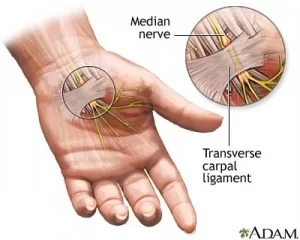
Carpal Tunnel Syndrome occurs when tissues surrounding the tendons in the tunnel become swollen, putting pressure on the median nerve. These tissues — called tendon sheaths — lubricate the tendons and aid in finger flexion. When they swell, the tunnel narrows, compressing the nerve.
Various factors can contribute to the development of CTS:
- Congenitally narrow carpal tunnel, potentially hereditary
- Chronic manual labor
- Hormonal changes during pregnancy
- Aging, typically affects older adults
- Medical conditions such as diabetes, rheumatoid arthritis, thyroid disorders
- Recent trauma to the wrist or hand, especially distal forearm fractures
In many cases, however, no clear cause is identified.
What Are the Symptoms of Carpal Tunnel Syndrome?
The most common symptoms include:
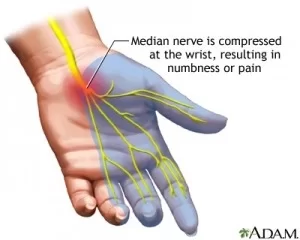
- Numbness and pain in the hand, often worse at night. The numbness typically affects the thumb, index, middle, and half of the ring finger. Many patients wake up at night and shake their hand to relieve symptoms.
- Tingling or pain that radiates up to the forearm and shoulder
- Electric shock-like sensations in the fingers
- In advanced cases: hand weakness leading to dropped objects or difficulty with fine movements (e.g., buttoning a shirt). Visible atrophy of the thenar muscles may occur.
Symptoms usually start gradually and worsen over time. They often intensify at night and may appear during activities like driving, reading, or holding a phone. Shaking the hand can provide temporary relief.
How Is Carpal Tunnel Syndrome Diagnosed?
Diagnosis starts with the patient’s medical history.
A physical exam includes sensory testing and evaluation of muscle strength in the hand. Specific clinical tests are used to reproduce symptoms.
Diagnostic Tests:
Electromyography (EMG): Confirms the diagnosis by measuring the nerve conduction in the hand.
Carpal Tunnel Syndrome Treatment Options
If left untreated, CTS typically worsens over time.
Get the Help You Need Today!
Conservative Treatment
When diagnosed early, CTS can often be managed without surgery.
If the cause is known (e.g., repetitive manual activity), modifying or stopping it may halt progression and reduce symptoms.
If symptoms persist, a wrist splint may be used, especially at night and during aggravating activities.
Non-steroidal anti-inflammatory drugs (NSAIDs) may also help.
If necessary, a cortisone injection can be administered locally.
Surgical Treatment
Surgery is recommended when conservative treatment fails or in more advanced cases, particularly with muscle weakness.
Open Surgery: Involves cutting the transverse ligament to relieve pressure on the median nerve through a small incision in the palm. It is performed under local anesthesia and lasts about 10–15 minutes. Hospitalization is not required.
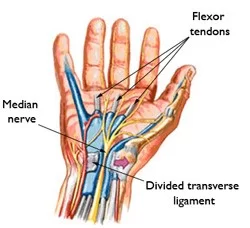
Endoscopic Surgery: A 1–2 cm incision is made just above the wrist under local anesthesia. Using a tiny camera, the surgeon views the ligament on a screen and releases it with a special blade. Surgery lasts 5–10 minutes.
Advantages of Endoscopic Surgery:
- Less postoperative pain
- Faster recovery
- Immediate hand use
- No scar on the palm
Long-term results are equally effective with both techniques.
Get the Help You Need Today!
Recovery Stages After Surgery
After surgery, the hand is bandaged, and a sling may be used to prevent swelling. Finger movement should begin immediately to reduce swelling.
Stitches are typically removed after about 2 weeks.
Pain and numbness often resolve quickly, but muscle weakness may take longer to recover — depending on how long and severely the nerve was compressed.
Daily activities are generally allowed shortly after surgery, avoiding heavy tasks.
Driving is usually possible once the patient feels comfortable. Returning to work depends on the job type and surgical method — typically 10 days (endoscopic), up to 3 weeks, except in heavy manual jobs which may take longer.
Possible Complications
Surgical complications are rare but may include:
- Hematoma
- Infection
- Nerve injury
Orthopedic Surgeon & Sports Medicine Specialist Dr. Anastasios Deligeorgis can provide you with further guidance and treatment options.
Book your appointment now!