
Trigger Finger: What is it?
Trigger finger is a condition in which a finger in the hand experiences difficulty and pain during movement and often gets stuck in a bent position. When trying to straighten the finger, there is a sensation that it is caught and it may suddenly release or “snap.” It can occur in any finger of the hand.
Anatomy
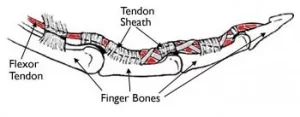
Tendons are a type of connective tissue that connect muscles to bones and enable movement of the limbs, in this case, the fingers. The flexor muscles are located in the forearm and, with the help of tendons running through the palm, they bend the fingers. These tendons are surrounded by a connective tissue sheath forming a tunnel in the palm, through which the tendon glides and is held close to the bone. This tunnel begins in the distal part of the palm just before the finger joint and extends along the fingers. Each time the tendon bends or straightens a finger, it moves—slides—within this tunnel.
How does trigger finger develop?
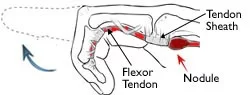
The tendon may experience friction and irritation as it moves inside the tunnel. As this worsens, both the tendon and its sheath may thicken, making movement within the tunnel difficult. Small nodules may form, which can nearly block the tendon from entering the tunnel.
In trigger finger, the tendon may get stuck inside the tunnel, making it temporarily impossible to straighten the finger. Sometimes the help of the other hand is needed to open the finger, which then suddenly snaps free.
Get the Help You Need Today!
Trigger Finger: What are the main causes?
In most cases, the causes are unknown. Some predisposing factors include:
- More common in women
- Age between 40–60
- Diabetes mellitus
- Rheumatoid arthritis
- After manual labor
What symptoms does trigger finger cause?
The most common symptoms include:
In advanced cases, the finger remains bent
Symptoms are usually worse in the morning and after long periods of inactivity.
- Pain when moving the affected finger
- Finger catching or locking during bending, often snapping suddenly when trying to straighten it
- A palpable and tender lump or “ball” in the palm
- Swelling
- In advanced cases, the finger remains bent
Symptoms are usually worse in the morning and after long periods of inactivity.
Diagnosis
Diagnosis is made based on medical history and clinical examination.
Trigger Finger: What should you do in conservative treatment?
Rest
If symptoms are mild and recent, a period of rest may help reduce or resolve the problem.
Medication
Treatment with non-steroidal anti-inflammatory drugs (NSAIDs) can also reduce symptoms, especially when combined with rest.
Cortisone
Before considering surgery in non-chronic cases, a local corticosteroid injection may be tried.
Trigger Finger: When is surgery recommended?
The decision for surgery depends on the patient and the severity of symptoms. In advanced cases with permanent stiffness, surgery is inevitable.
The surgery is performed under local anesthesia. No hospitalization is required, and the procedure lasts about 10 minutes.
During the operation, a small incision about 1 cm long is made in the palm near the base of the finger. Then, the tunnel is opened and the tendon is released.
Get the Help You Need Today!
Recovery
Immediately after surgery, hand movement is allowed. Recovery usually takes a few weeks and depends on how long the condition has been present. Rarely, physical therapy may be necessary.