
What is a Shoulder Tendon Tear?
A shoulder tendon tear is a common cause of shoulder pain. It leads to reduced muscle strength and loss of smooth shoulder motion, making even simple daily activities—such as brushing hair or getting dressed—difficult and painful.
What is the Anatomy of the Shoulder?
The shoulder is a complex joint with the greatest range of motion of any joint in the body. It is where the upper arm bone (humerus) meets the shoulder blade (scapula) and the outer end of the collarbone (clavicle).
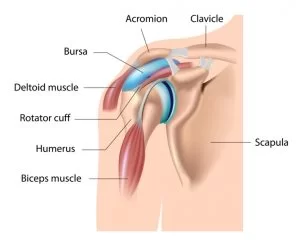
The upper part of the humerus consists of the humeral head, which is ball-shaped and sits opposite the socket-shaped glenoid cavity of the scapula. These two surfaces are covered by articular cartilage—a smooth layer that allows for frictionless movement and helps absorb shock during motion and load-bearing.
Glenoid Labrum: The edge of the glenoid is surrounded by a strong fibrous cartilage called the labrum. This cartilage deepens the socket, contributes to joint stability, and helps absorb impact.
Joint Capsule: The shoulder joint is enclosed in a joint capsule that produces synovial fluid for lubrication. It is also supported by various ligaments that contribute to joint stability.
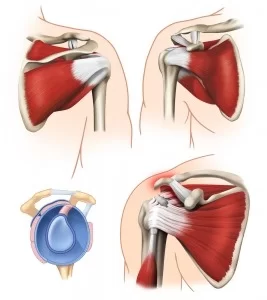
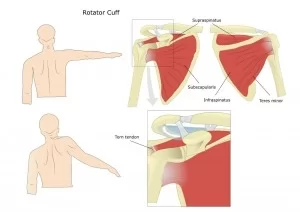
Rotator Cuff: Four tendons surround the shoulder joint, keeping the humeral head centered in the shallow socket of the glenoid. These tendons form a cuff that covers the humeral head and connects it to the shoulder blade. The rotator cuff consists of the tendons of the supraspinatus, infraspinatus, subscapularis, and teres minor muscles. In addition to stabilizing the joint, these muscles help lift the arm and perform rotational movements.
Subacromial Bursa: Above the rotator cuff and beneath the acromion (the bony part of the scapula above the humeral head), there is a fluid-filled sac called the subacromial bursa. This bursa produces fluid and allows smooth gliding of the rotator cuff over the humeral head during arm elevation. When the rotator cuff tears, this bursa often becomes inflamed and painful.
What Types of Rotator Cuff Tears Exist?
When one or more of the rotator cuff tendons are torn, they lose their attachment to the humeral head. Most tears occur in the supraspinatus tendon.
There are two main types of tears:
- Partial Tear: The tendon is damaged but not completely severed. The damage may occur on the articular side (facing the joint) or on the bursal side (facing the bursa).
- Full-Thickness or Complete Tear: The tear extends through the entire thickness of the tendon, effectively creating a hole in it.
Tears are also classified based on their size, whether they span the entire width of the tendon or only part of it, and whether one or multiple tendons are involved.
What Causes a Shoulder Tendon Tear?
There are three types of tendon tears: sudden-acute (traumatic), chronic-degenerative, and mixed tears.
Traumatic Tears
These usually result from a fall with the arm outstretched or during a sudden lifting of weight with poor control. They may also be associated with other shoulder injuries such as dislocation or clavicle fracture.
Degenerative Tears
These tears develop progressively over time due to tendon degeneration, often seen in the dominant arm and with increasing age.
Factors Contributing to Degenerative or Chronic Tears:
- Repetitive Microtrauma:
Repetitive shoulder movements, especially those that push the joint to its limits, can cause microtears in the rotator cuff. Sports such as basketball, tennis, volleyball, swimming, weightlifting, and manual labor can lead to overuse and eventually degenerative tears. - Reduced Blood Supply:
As we age, blood flow to the rotator cuff decreases, which lowers its ability to heal and increases the likelihood of a tear from even minor injuries. - Bone Spurs (Osteophytes):
Bony growths, especially on the underside of the acromion, can repeatedly irritate the tendon, increasing the risk of tearing.
Mixed Tears
These occur in individuals who already had a degenerative tear—often with minimal or no symptoms—and who suffer a trauma, such as a fall, causing the tear to enlarge and symptoms to worsen.
What Are the Symptoms of a Shoulder Tendon Tear?
The most common symptoms of a rotator cuff tear include:
- Pain (especially when lifting the arm or lying on the affected shoulder)
- Weakness in the arm
- Limited range of motion
- Difficulty performing everyday activities like dressing or reaching overhead
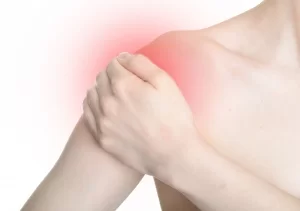
In overuse-related tears, pain and weakness may also be present. The pain may be localized in the shoulder, may radiate down the arm, or worsen when lifting the arm to the side. Using the arm above shoulder level can be difficult due to pain and weakness.
Get the Help You Need Today!
How is a shoulder tendon tear diagnosed?
History and Clinical Examination
The diagnosis of a rotator cuff tear is based on the patient’s history, symptoms, and clinical examination. The clinical examination includes checking the range of motion, muscle strength, tenderness points, and specific clinical tests.
Imaging
Confirmation of the diagnosis is done through MRI, CT or MR arthrography, and ultrasound. Simple X-rays help rule out other conditions.
Shoulder Tendon Tear: What is the Appropriate Treatment?
A tendon tear should be treated promptly to prevent further damage, eliminate pain, and avoid permanent loss of muscle strength. In cases of complete tears, if left untreated, there is also a risk of developing arthropathy in the future.
Treatment is individualized based on the size of the tear, its chronicity, the presence of arthritis, the condition of the muscles (including any atrophy), the quality of the tendon, as well as the patient’s age, activity level, and other shoulder-related issues.
Conservative Treatment
About half of patients treated conservatively experience pain relief and improved mobility. However, muscle strength usually does not return unless surgery is performed.
In cases where necessary surgical treatment is neglected for a long time, the size of the tear increases, the muscles atrophy, and the tendons degenerate to such a degree that arthroscopic repair and subsequent recovery become very difficult or even impossible.
Conservative treatment includes:
- Rest – Reducing overhead activities
- Avoiding movements that cause pain
- Taking pain relievers and non-steroidal anti-inflammatory drugs
- Physiotherapy with mobilization and strengthening exercises for the rotator cuff and shoulder girdle muscles
- Cortisone injections into the joint, usually at the site of most intense pain
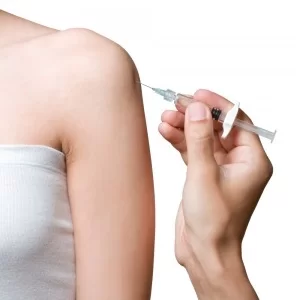
Newer conservative approaches include promising biological therapies that rely on the body’s regenerative capabilities:
- Stem Cell Therapy
- Platelet-Rich Plasma Therapy (PRP)
Arthroscopic Repair of the Tear
When conservative methods fail to reduce pain and restore functionality, modern treatment for rotator cuff tears is shoulder arthroscopy.
Shoulder arthroscopy is a minimally invasive method used for better diagnosis and treatment of various joint injuries. It allows viewing the inside of the joint without damaging it.
Using a tiny camera and specially designed micro-instruments, through millimeter-sized incisions, a specialized orthopedic surgeon can repair or reattach the torn tendon to its correct anatomical position on the humeral head. The repair and reattachment are done with specially designed implantable materials (anchors) and bioabsorbable sutures.
For faster tendon healing, stem cells may also be injected into the shoulder joint after the arthroscopy.
The patient does not require hospitalization and returns home the same day, just a few hours after the procedure.
The key advantage of arthroscopic repair is that the joint is not opened, soft tissues are respected, muscles are not damaged, there are no large incisions, and hospitalization is not necessary.
Reverse Shoulder Arthroplasty
Neglected and large, irreparable tears in older patients can lead to shoulder joint arthritis (rotator cuff arthropathy). In such cases, reverse total shoulder arthroplasty is recommended. This involves total joint replacement with an artificial prosthesis during which the normal anatomy of the shoulder is reversed. This allows the joint to function without relying on the rotator cuff.
The artificial prosthesis is made of body-friendly and highly durable materials. The procedure typically lasts about 2 hours, and the patient stays in the hospital for one day.
Get the Help You Need Today!
In Space Balloon: What Is It?
In some cases of chronic tears where there is significant muscle atrophy and tendon degeneration, restoring the continuity of the tendon or reattaching it to the humeral head is not possible. In these cases, provided there is no arthritis, a new pioneering method is applied to substitute the rotator cuff tendon with a subacromial implant known as the “In Space Balloon.”
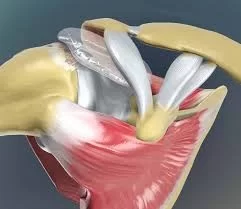
This implant is placed under the acromion and above the humeral head, in the position normally occupied by the subacromial bursa. The implant, which resembles a balloon, is made of bioresorbable material that disappears after about one year. Its purpose is to keep the humeral head centered opposite the glenoid cavity, which is normally done by the rotator cuff tendon, while simultaneously making movement painless by preventing upward displacement of the humeral head and its impingement against the acromion. This way, the patient can follow a physical rehabilitation program aimed at fully restoring the shoulder’s range of motion.
How is rehabilitation done with the In Space Balloon method?
Rehabilitation plays a very important role in helping the patient return to their daily activities. After surgery, and to protect the shoulder until the tendon heals, the patient must use a brace (splint) to immobilize the arm for 3 to 6 weeks. Afterwards, they must follow a specialized rehabilitation program so that the shoulder can regain its range of motion and muscle strength.
The duration of rehabilitation varies depending on the severity of the injury, the patient’s compliance with restrictions, and their functional needs. Return to simple daily activities and office work (typing, writing) is immediate, while full activities are resumed approximately within 2½ to 3½ months. In some cases, returning to full athletic activity or heavy manual labor may require up to six months.