
Ankle Sprain: What Is It?
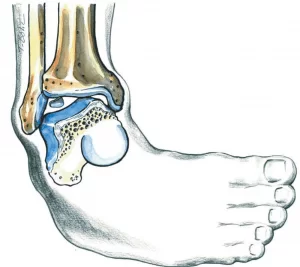
When we talk about an ankle sprain, we’re referring to what most people commonly describe as “twisting” or “rolling” the ankle.
Traumatic ankle sprains are quite common, accounting for about 10% of all injuries treated by physicians. Ligament injuries of the ankle are the most frequent sports-related injuries, representing approximately 20% of all athletic injuries. In some sports—especially team sports such as football (soccer), basketball, volleyball, and handball—this rate can reach up to 50%.
Anatomy
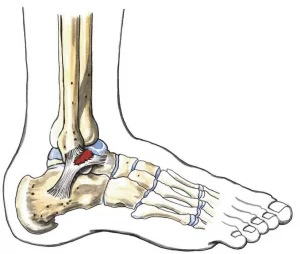
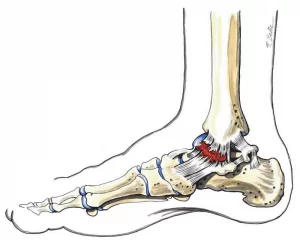
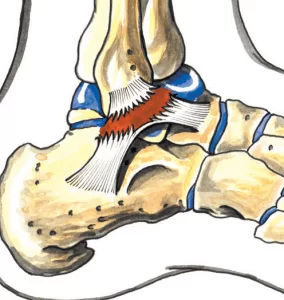
The ankle joint (talocrural joint) is formed by the meeting of three bones: the distal ends of the tibia and fibula, and the talus. These bones are held together by a group of ligaments that protect the joint from abnormal movements and injuries.
Ligaments are elastic by nature and can return to their normal length after stretching within their limits. However, when they are stretched forcefully beyond their capacity, they may suffer from overstretching, partial tearing, or even complete rupture.
Get the Help You Need Today!
Mechanism of Injury
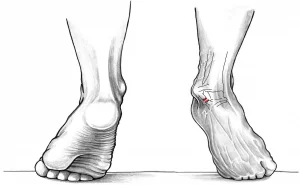
Ankle sprains occur when the foot twists, turns inward (inversion) or outward (eversion), or bends in an abnormal way, forcing the ligaments beyond their elastic limit. This can happen due to tripping on uneven ground or landing awkwardly from a jump. Depending on the force, the mechanism, and the extent of the stretch, one or more ligaments may be injured—from mild stretching to complete rupture.
Sprains are classified into three degrees:
- Grade I: Mild stretching of the ligament
- Grade II: Partial tear of ligament fibers
- Grade III: Complete tear of the ligament, potentially causing joint instability
What Are the Symptoms of an Ankle Sprain?
The main symptoms include pain and swelling, which generally reflect the extent of ligament damage. Walking may be difficult. Joint instability may occur with complete ligament ruptures and usually becomes more noticeable after the acute symptoms subside.
How Is an Ankle Sprain Diagnosed?
Diagnosis is based on the injury history and clinical examination. The patient usually shows tenderness and swelling around the injured ligament. X-rays are used to rule out any fractures.
If a more severe injury is suspected—such as a significant ligament tear or damage to the articular cartilage—an MRI may be performed at a later stage, once acute symptoms have lessened. Complete ligament tears may lead to chronic instability, increasing the risk of cartilage damage.
What Is the Proper Treatment for an Ankle Sprain?
Conservative Treatment
An orthopedic surgeon’s evaluation is important to determine the severity of the injury and rule out any fractures.
In the first hours and days after the injury, treatment focuses on relieving symptoms and minimizing swelling as much as possible.
- Ice therapy (using ice wrapped in a towel or a cold pack) 3-4 times a day for 15-20 minutes.
(Caution: Risk of ice burn if applied for longer periods) - Elevating the foot, ideally above heart level.
- Compression using an elastic bandage.
- Rest depending on symptoms. In cases of severe pain or difficulty walking, partial weight-bearing with crutches may be necessary.
Depending on the severity of the sprain, symptoms may take 3 to 6 weeks to resolve.
In Grade II and III sprains, more rigid immobilization may be necessary for proper ligament healing.
Physical therapy and early mobilization help reduce symptoms in the initial stages and allow for a gradual and safer return to activities after the acute phase.
In particular, balance, strengthening, and proprioception exercises play a major role in preventing recurrence.
The total recovery time depends on the severity of the injury and may last several months.
Recovery After an Ankle Sprain Involves 3 Phases:
- Phase 1 (Week 1):
Rest, protection from further injury, and symptom reduction. - Phase 2 (Usually weeks 1–3 depending on severity):
Restoration of range of motion, muscle strength, and joint flexibility. - Phase 3:
Gradual return to daily activities, followed by a progressive return to sports using sport-specific exercises.
(Duration: Several weeks to a few months)
Get the Help You Need Today!
Surgical Treatment
Surgical treatment is rarely needed, and only in severe Grade III sprains involving a complete rupture of one or more ligaments, cases where conservative treatment fails, resulting in chronic instability, or in the presence of intra-articular damage.
Surgical treatment includes:
- Ankle arthroscopy to detect and treat any intra-articular injuries.
- Ligament repair or reconstruction of the torn ligaments.
Surgical repair is always followed by a specialized rehabilitation program.
What’s the Best Way to Prevent an Ankle Sprain?
The best prevention is maintaining good muscular strength, muscle balance, and ligament flexibility.
- Proper warm-up
- Appropriate sports gear (e.g., supportive footwear)
- Avoiding overexertion (most injuries happen when the athlete is tired)