
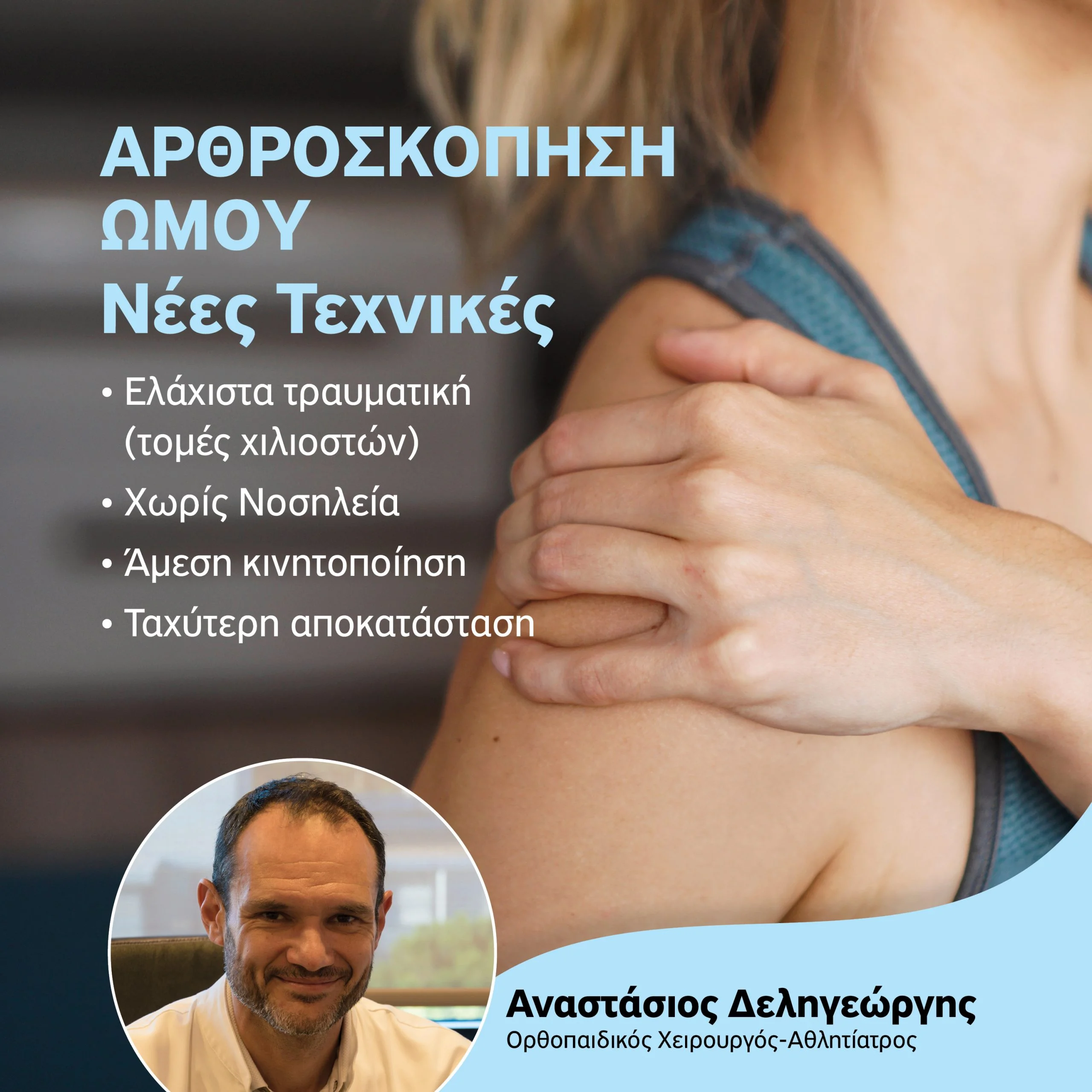
Shoulder arthroscopic surgery has seen rapid growth in recent years, constantly developing new techniques and specialized tools/materials that make it increasingly less invasive. The minimally invasive approach is characterized mainly by very small incisions (only a few millimeters) and minimal tissue trauma. It contributes to immediate mobilization, minimal hospitalization, and a quick return to daily activities.
What is Shoulder Arthroscopy?
Shoulder arthroscopy is a minimally invasive procedure that allows direct visualization of the inside of the joint, enabling accurate diagnosis and immediate repair of shoulder injuries, typically without the need for hospitalization.
Through a small incision (about 3–5 mm), the orthopedic surgeon inserts an arthroscope — a device equipped with a tiny camera and powerful light — into the shoulder joint. The camera transmits a high-definition, magnified image of the joint to a monitor.
This gives the surgeon the ability to:
- Closely examine the joint’s interior and identify even the smallest lesions in hard-to-reach areas
- Repair the damage using specially designed, fine instruments and implantable inert materials such as sutures and anchors
The incisions are minimal (compared to large open surgical cuts), which results in reduced damage to muscles and surrounding tissues. This minimizes potential complications and postoperative pain. Any minor scarring typically fades within a few months.
In some cases, biological treatments (such as stem cell injections or platelet-rich plasma – PRP) combined with arthroscopy can significantly enhance tissue healing and recovery.
Most shoulder arthroscopies last no more than one hour. The procedure is performed using a combination of regional and mild general anesthesia, depending on the patient’s medical history, and the patient can usually return home the same day.
New Arthroscopic Techniques
Different advanced arthroscopic techniques are applied based on the type and severity of the shoulder damage.
In mild cases, immediate repairs are performed (e.g., tendon suturing, adhesion release), while in more severe cases, complex and advanced techniques based on international best practices are used. Examples include:
- For massive, irreparable rotator cuff tears, reconstruction of the superior capsule using a graft from the patient (autograft) or tendon transfers may be performed to restore muscle function
- In cases of recurrent dislocations or significant bone loss in the shoulder joint, bone block procedures using autologous bone grafts (typically from the iliac crest) or coracoid process transfer (Latarjet technique) may be used
- In rotator cuff tears, especially chronic ones, reinforcement of the repair is needed — both mechanically and biologically. This can involve stem cells, PRP, cells from the subacromial bursa, or autologous tendon grafts to enhance healing and improve outcomes
Advances in shoulder arthroscopy are not limited to techniques but also extend to the materials used. New “low-profile” materials are being introduced — more durable, high-tech, and biocompatible.
For example, all-suture anchors are now widely used. These are much smaller than traditional anchors, made entirely of sutures instead of metal or other hard materials.
Thanks to these new, smaller anchors:
- More anchors can be used in the same space, providing stronger repairs
- MRI scans can be performed postoperatively to assess the repair and tendon integrity, which was not feasible with older metal anchors
- Revision surgery, if needed, is much easier due to the absence of bulky metal components
Advantages of Shoulder Arthroscopy
- Minimally invasive technique
- Minimal tissue trauma (tiny incisions)
- High diagnostic accuracy (detailed joint visualization)
- No hospitalization required
- Significantly reduced risk of complications
- Minimal postoperative pain
- Immediate mobilization
- No noticeable postoperative scarring
- Rapid return to daily activities
- More effective and faster recovery process