
Arthroplasty with Navigation
The application of digital navigation techniques (computer navigation) using navigators offers absolute precision, minimal invasiveness, and much better outcomes in arthroplasty. At the same time, it helps minimize hospitalization—usually just 1 day instead of 3–4 days—and enables rapid patient recovery (fast-track).
What is arthroplasty and what is a navigator?
In arthroplasty, the damaged surface of a major joint (shoulder, hip, knee) caused by arthritis (typically in people over 60 years old) or trauma is replaced by an artificial (metallic, plastic, or ceramic) surface that performs all the movements of a natural joint and eliminates the patient’s pain.
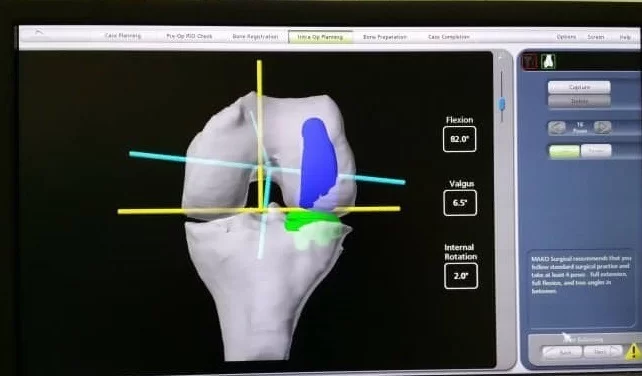
A navigator is a state-of-the-art digital system that provides exceptional precision during the arthroplasty, ensuring high safety for the patient. It contributes significantly to both the preoperative planning of the surgery based on 3D CT images and every step of the procedure by providing detailed instructions via graphics and text.
Arthroplasty with navigation: Benefits for the patient
In the past, all necessary measurements, both preoperative and intraoperative, were done approximately using mechanical guides. Today, however, the use of advanced navigators such as Navio allows a properly trained orthopedic surgeon to take highly accurate and detailed measurements of the hip or knee joint. This enables the placement of the new joint in the most appropriate position for each patient.
This precision in preparation and implant placement results in only minimal and small incisions (minimal invasiveness), significantly reduces postoperative pain and risk of complications, accelerates recovery, and allows for the long-term survival of the prosthetic material.
In hip arthroplasty, the navigator also provides the ability to precisely calculate the length of the operated leg, ensuring the patient’s legs are balanced (no difference in length between the operated and original leg). This greatly improves the postoperative function of the operated hip by preventing strain on the opposite leg and avoiding limping.
Arthroplasty with navigation: Advantages
- Shorter hospitalization (usually 1 day)
- Lower risk of complications
- Reduced postoperative pain
- Immediate mobilization (as soon as the patient “wakes up” from anesthesia)
- Faster recovery
- Better functional outcome
- Longer lifespan of the implant
For hip arthroplasty specifically:
- Proper alignment of the acetabulum (the socket part of the hip joint)
- Implant placement with exceptional accuracy for correct orientation
- Ensuring leg length equality of the patient (no difference in hip lengths)