
Meniscus Tear: What Is It?
A meniscus tear is one of the most common knee injuries. While anyone can suffer a meniscus tear, athletes—especially those who play team sports like basketball, soccer, and volleyball—are more prone to it.
Anatomy
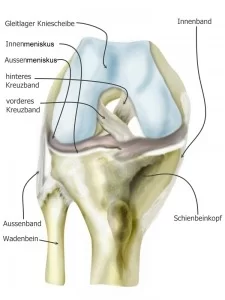
The knee joint is where the lower end of the femur meets the upper end of the tibia and the kneecap (patella).
There are two menisci in each knee—medial (inner) and lateral (outer)—which are tough, elastic anatomical structures composed mainly of water and collagen fibers. Specifically, their composition includes:
- 75% water
- 20% type I collagen
- 5% other components such as proteoglycans, elastin, fibrochondrocytes, and type II collagen.
Shaped like a crescent or horseshoe, the menisci are located between the articular surfaces of the tibia and femur. Their primary role is to absorb load, improve the contact area between the femur and tibia, stabilize the joint, lubricate the knee, and contribute to smoother movement.
Mechanism of a Meniscus Tear
An acute meniscus tear usually occurs in young individuals during sports activities but can happen during any movement involving rotational and compressive forces that exceed the meniscus’s tolerance. The typical mechanism involves loading a bent knee with simultaneous twisting.
Older patients may suffer degenerative meniscus tears due to minor repetitive injuries. Age-related weakening of the tissue makes them more vulnerable—even simple movements like standing up or deep squatting can lead to a tear.
Get the Help You Need Today!
How Are Meniscus Tears Classified?
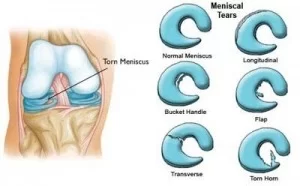
Meniscus tears are classified based on:
- Shape: radial, horizontal, or complex
- Location: anterior horn, posterior horn, or body of the meniscus
- Zone: whether the tear is in the outer (vascular) third or the inner (non-vascular) two-thirds
Special types include:
- Root lesions: tears at the attachment point of the meniscus
- Ramp lesions: tears at the junction of the posterior horn and the joint capsule
What Are the Main Symptoms of a Meniscus Tear?
At the moment of injury, you might feel or even hear a popping sound. Sometimes, the individual may continue the activity, but swelling and stiffness in the knee may develop over time.
Typical symptoms include:
- Pain on the inner or outer side of the knee (depending on which meniscus is torn), which worsens when bending the knee (e.g., deep squatting or climbing stairs)
- Swelling and stiffness
- Locking or catching of the knee if a torn fragment is displaced
- A feeling of instability
How Is a Meniscus Tear Diagnosed?
Diagnosis is based on the patient’s medical history and clinical examination using special tests. MRI is often used to confirm the diagnosis, rule out other injuries, and plan the appropriate treatment.
What Is the Proper Treatment for a Meniscus Tear?
Early treatment is recommended—either conservative or surgical—as delays may lead to further cartilage damage or worsening of the tear.
Small, chronic degenerative tears with mild symptoms can be managed conservatively with:
- Rest
- Ice therapy
- Elastic knee bandaging
- Non-steroidal anti-inflammatory drugs (NSAIDs)
- A specialized physiotherapy and strengthening program
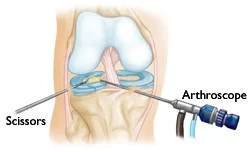
All other tears, or those that do not respond to conservative therapy, are typically treated with arthroscopy.
Arthroscopic Treatment
Meniscus arthroscopy is a method through which, using two very small incisions of just a few millimeters, a tiny camera and microsurgical tools are used to identify and treat various intra-articular injuries using the most appropriate technique. The patient is discharged from the hospital on the same day.
There are three (3) treatment methods: removal of the damaged part (partial meniscectomy), repair/suturing of the tear, or a combination of both.
The method chosen depends on the location and type of tear, any accompanying injuries, as well as other factors such as the patient’s age, activity level, and the specific anatomical structure of the knee.
Partial meniscectomy allows for a rapid return to daily activities, but removing part of the meniscus increases the risk of long-term knee degeneration. Suturing is the best option, as it preserves the natural function of the knee, but it requires a long rehabilitation period.
Meniscus Repair – Suturing
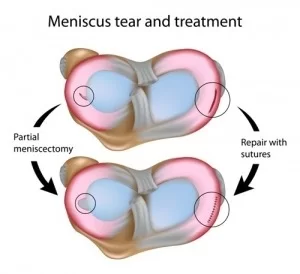
If the tear is located in the peripheral area of the meniscus, which has a natural blood supply, the meniscus can be sutured and stabilized to preserve it. This method is mainly recommended for younger patients.
There are various suturing techniques using specialized stitches, depending on the location and type of the tear. The most common techniques include all-inside, inside-out, and outside-in, which are constantly being optimized. Meniscus suturing is a technically demanding procedure.
Get the Help You Need Today!
“Root Lesions”
These are radial tears at the “root” of the meniscus — the point where the front or rear horn of the meniscus connects to the tibial bone.
The most common and serious injury is that of the posterior horn. It is often associated with ligament injuries such as an anterior cruciate ligament (ACL) tear.
Recent studies have shown that if this particular injury is not repaired, the protective function of the meniscus is lost, essentially equating it to a full meniscectomy. This can lead to early arthritis or spontaneous osteonecrosis. The treatment involves reattaching the root to its anatomical position using specialized arthroscopic techniques.
“Ramp Lesions”
These are injuries that affect the connection between the meniscus and the joint capsule. They are also known as “hidden” injuries, as they may not be visible even on MRI or during arthroscopy. They are found in the posterior horn of the medial meniscus and are often present alongside ACL tears. These tears cause instability of the meniscus and, if not treated, can lead not only to knee symptoms but also to early arthritis.
Diagnosis and treatment require the use of a third posterior arthroscopic portal through which the tear is both diagnosed and sutured.
Partial Meniscectomy
When the tear is located more centrally, in an area with no natural blood supply, only the damaged part is removed (partial meniscectomy), preserving as much of the meniscus as possible.
Recovery
Following arthroscopic treatment, the patient must follow a rehabilitation program in order to fully return to daily activities.
Recovery time depends on the type of tear and the treatment performed. In partial meniscectomy, the patient typically returns to daily activities within a few days after the procedure and to sports activities in 10–20 days. In cases where arthroscopic suturing is performed, the patient must offload the leg using crutches for about 1 month, and return to sports activities may occur after 3–4 months.