
Knee Arthritis: What Is It?
Knee arthritis is an inflammatory condition characterized by the degeneration of the structural components of the joint, including the articular cartilage, the menisci, and the subchondral bones.
The main symptoms are pain, swelling, and stiffness, and it can cause significant difficulty in daily activities and even lead to serious disability. The knee is one of the most commonly affected joints.
The most common types of knee arthritis are:
- Rheumatoid arthritis
- Osteoarthritis
- Post-traumatic arthritis
What Is the Anatomy of the Knee?
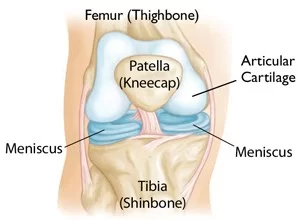
The knee is the largest and strongest joint in the human body.
It consists of the distal end of the femur (thighbone), the proximal end of the tibia (shinbone), and the patella (kneecap). The parts of these bones inside the joint are covered by articular cartilage, a smooth surface that allows frictionless movement and absorbs shock during motion and weight-bearing activities.
Between the two articular surfaces of the femur and tibia lie the menisci, two crescent-shaped pads that improve contact between the cartilage surfaces and contribute to shock absorption.
The knee joint is surrounded by the synovial capsule, a thin membrane that produces synovial fluid, which lubricates and nourishes the cartilage and reduces friction.
Knee stability is supported by both ligaments and muscles with their tendons.
- The joint is stabilized laterally by the medial and lateral collateral ligaments.
- It is also stabilized anteroposteriorly and rotationally by the cruciate ligaments, which form an X shape inside the joint.
- The anterior cruciate ligament (ACL) prevents forward movement of the tibia.
- The posterior cruciate ligament (PCL) prevents backward movement.
Several strong muscles (quadriceps, hamstrings, adductors) work together to move and stabilize the joint during walking, sports, etc. These muscles attach to bones through tendons. The coordination of all the knee muscles is essential for smooth joint function.
Get the Help You Need Today!
How Many Types of Knee Arthritis Are There?
Osteoarthritis
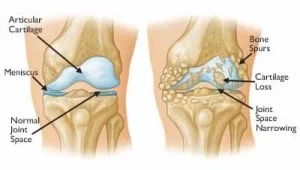
Osteoarthritis of the knee is the most common form. It results from the progressive degeneration of the knee components, especially the articular cartilage. It typically affects people over 50–60 years old but can occasionally appear in younger individuals.
As cartilage deteriorates, it loses its smooth surface and thins, leading to bone-on-bone contact, which causes pain during movement. Osteoarthritis progresses slowly, and symptoms worsen over time.
Post-Traumatic Knee Arthritis
This form occurs after injury, fracture, or tears of the meniscus or ligaments, which lead to joint instability and further cartilage damage, potentially resulting in arthritis over time.
Rheumatoid Arthritis
Rheumatoid arthritis is a chronic autoimmune disease that affects multiple joints, including the knees. The body’s immune system attacks its own tissues, leading to destruction of cartilage, ligaments, and bones. It often affects both knees simultaneously.
What Are the Main Symptoms of Knee Arthritis?
- Pain, stiffness, and swelling are the main symptoms.
- Symptoms usually develop gradually but may also appear suddenly.
- Initially, pain and stiffness are worse in the morning or after standing up from a sitting position.
- Over time, the pain worsens with activity and may become constant in advanced stages.
- The knee may become stiff, limiting full extension and flexion.
- Loose fragments of cartilage or meniscus may interfere with movement, causing locking or grinding sensations.
- Due to pain, the muscles may weaken and atrophy, leading to a feeling of instability.
- The knee may feel warm, reddish, and swollen.
- Many patients report increased pain during weather changes, especially with humidity.
How Is Knee Arthritis Diagnosed?
Diagnosis is based on medical history and clinical examination, and is confirmed by X-rays.
In some cases, MRI may be required.
Blood tests may be necessary to rule out other conditions and identify the specific type of arthritis.
Knee Arthritis: What is the Right Treatment?
There is no definitive cure for knee arthritis. However, there are treatments aimed at reducing or even eliminating pain and improving the range of motion.
Conservative Treatment
In the early stages of knee arthritis, and depending on the symptoms, conservative approaches may help manage the condition.
- Activity modification: Avoid activities that trigger symptoms, such as going up and down stairs. Incorporate exercises into daily life that strengthen the muscles supporting the knee while maintaining or improving mobility. Swimming is an excellent low-impact exercise.
- Physical therapy: Physiotherapy combined with muscle-strengthening exercises around the knee can reduce pain and preserve joint function.
- Medication: Painkillers and non-steroidal anti-inflammatory drugs (NSAIDs) may help relieve symptoms in the early stages.
- Injections:
- Local injections of hyaluronic acid or cortisone can help.
- More advanced and promising biological therapies include:
- Platelet-Rich Plasma (PRP) injections
- Stem Cell (STEM CELLS) therapy
These options may reduce symptoms and slow disease progression.
According to the latest international guidelines by ESSKA (European Society for Sports Traumatology, Knee Surgery and Arthroscopy), for early to moderate knee osteoarthritis, intra-articular PRP injections are considered more effective than hyaluronic acid or cortisone injections.
- Dietary Supplements:
Supplements containing elements found in healthy cartilage — such as glucosamine, chondroitin, collagen, and hyaluronic acid — are available on the market. The idea is that by supplying these building blocks, the body may slow down arthritis progression. While some patients report reduced pain, scientific studies have not conclusively confirmed their effectiveness, likely due to poor absorption or breakdown of these substances in the body.
Surgical Treatment
Surgical Treatment
When conservative treatments fail and the patient’s quality of life is significantly impacted, surgery may be recommended.
Get the Help You Need Today!
Arthroscopy
For early-stage arthritis, particularly when symptoms have appeared suddenly and MRI shows meniscus tears or loose bodies, arthroscopy may be an option. It is mainly recommended for younger patients.
Osteotomies
In younger individuals with arthritis affecting only one compartment of the knee, an osteotomy can be performed. This procedure shifts the load from the damaged area to the healthy compartment by altering the knee’s mechanical axis. Osteotomies can relieve pain and improve mobility.
Knee Replacement (Arthroplasty)
- Unicompartmental Knee Replacement
- Total Knee Replacement
Arthroplasty involves replacing the arthritic and damaged surfaces of the knee with a specialized prosthesis. It is reserved for patients with advanced arthritis after conservative options have been exhausted.
There are several surgical approaches, from traditional total knee replacement to Minimally Invasive Surgery (MIS) and Customized Total Knee Arthroplasty.
Modern MIS techniques involve smaller incisions, respect anatomical structures, cause less trauma, reduce blood loss, and enable faster recovery.